🪙 What Are Cryptocurrencies?
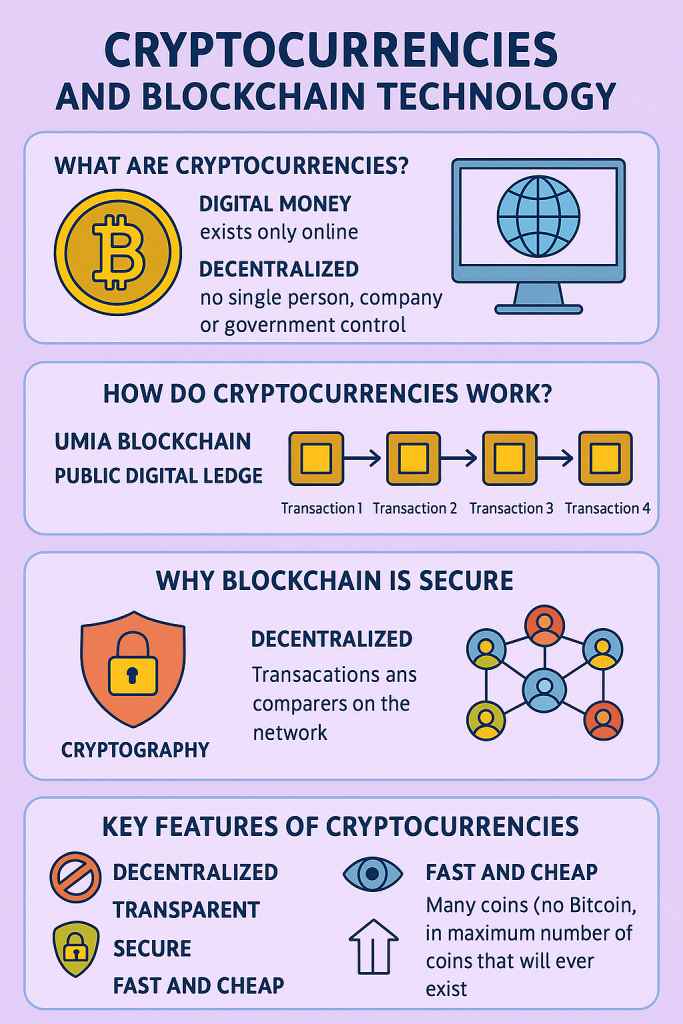
Cryptocurrencies are digital or virtual money that exists only online. Unlike traditional money (like pounds or dollars) controlled by governments and banks, cryptocurrencies are decentralized. This means no single person, company, or government controls them.
The most famous cryptocurrency is Bitcoin, created in 2009. Others include Ethereum, Litecoin, and Solana.
People use cryptocurrencies to:
- Buy goods and services online
- Invest and trade (similar to stocks)
- Send money globally quickly and cheaply
🧠 How Do Cryptocurrencies Work?
Cryptocurrencies work using a technology called blockchain.
A blockchain is like a digital public ledger — a big book of transactions that everyone can see but no one can secretly change.
📊 Simple Graphic – How Blockchain Works
Transaction 1 ---> Transaction 2 ---> Transaction 3 ---> Transaction 4
      |                  |                  |                  |
      v                  v                  v                  v
  [ Block 1 ] -----> [ Block 2 ] -----> [ Block 3 ] -----> [ Block 4 ]
- Each block stores a list of recent transactions.
- Each new block links to the previous block, forming a chain.
- Once information is added, it’s permanent and tamper-proof.
🔐 Why Blockchain Is Secure
Blockchain uses cryptography (complex math codes) to keep data safe.
When you make a transaction, it is:
- Verified by many computers on the network (called nodes)
- Added to a block
- Linked to previous blocks using a unique cryptographic hash (a digital fingerprint)
Because thousands of computers keep copies of the blockchain, hacking it is nearly impossible. Changing one block would require changing all blocks on all computers at once.
🖥️ Simple Graphic – Decentralized Network
         [User A]
           / | \
          /  |  \
 [User B] [User C] [User D]
          \  |  /
           \ | /
         [User E]
There’s no central server — everyone connects to everyone. This is called a peer-to-peer network.
💸 Key Features of Cryptocurrencies
- Decentralized: No banks or governments control them
- Transparent: Anyone can see transactions on the blockchain
- Secure: Protected by encryption and verified by thousands of computers
- Fast and cheap: Especially for international transfers
- Limited supply: Many coins (like Bitcoin) have a maximum number of coins that will ever exist, making them scarce
⚡ Why It Matters
Cryptocurrencies and blockchain could transform many industries. Beyond money, blockchains can record:
- Property ownership
- Medical records
- Supply chain tracking
- Digital art (NFTs)
They give people more control, privacy, and global access to financial tools.
📌 Summary Graphic
Cryptocurrency = Digital Money
         |
         v
Blockchain = Public Digital Ledger
         |
         v
Decentralized + Secure + Transparent